Why You Need an Expansion Tank for Your Water Heater in Aurora
Colorado code may require an expansion tank with your new water heater. Learn why it matters and what it costs for Aurora homeowners.

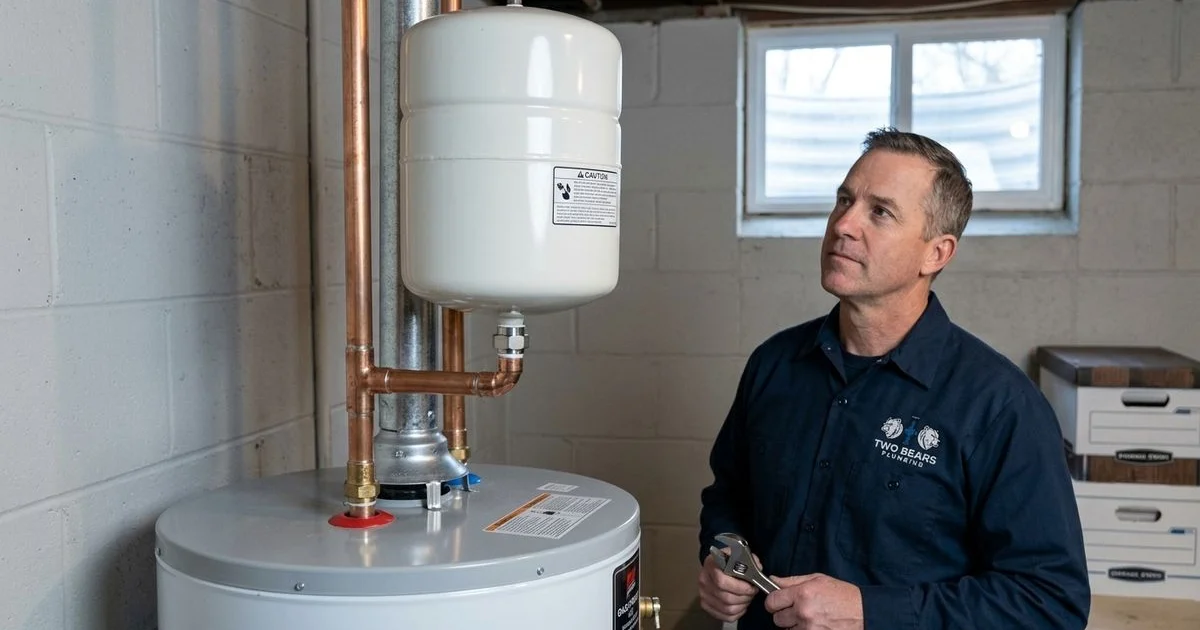
We see the same reaction every week from homeowners wondering why you need an expansion tank for your water heater in Aurora. You get the estimate, scan the line items, and spot an unfamiliar charge for this extra equipment.
It definitely sounds like a classic plumber upsell.
Our job is to protect your property and your wallet, so we want to be completely transparent about this little metal canister. It is a strict municipal code requirement that actively prevents catastrophic pipe bursts. Let us look at the actual physics of heating water, the specific plumbing codes we follow, and a few practical ways to maintain this crucial safety device.
What Is a Thermal Expansion Tank?
We always start by explaining the physics of your plumbing. Heating a standard 40-gallon tank of cold water to 140 degrees adds almost a half-gallon of extra volume to the system.
Water cannot be compressed, so that extra mass has to go somewhere. Our older homes in Colorado used to have “open” systems, meaning the expanding liquid just pushed back out into the public water main. Modern public safety regulations changed that.
City water meters now feature backflow preventer valves to keep contaminated water out of the public supply. This creates a “closed system” in your home, trapping the pressure inside your pipes.
We measure this pressure in pounds per square inch (psi). Without an expansion tank, heating a fresh tank of water can rapidly spike your internal pipe pressure over 150 psi. That level of extreme stress leads to several expensive problems:
- Premature water heater failure: The metal tank flexes and cracks under repeated pressure cycles.
- Leaking safety valves: The temperature and pressure relief valve must open to prevent an explosion.
- Burst pipe joints: Hidden fittings behind walls and under floors take the brunt of the force.
- Appliance damage: Dishwashers and ice makers sustain broken internal seals.
An expansion tank is a small, heavy-duty steel vessel that mounts directly to your cold water supply line. Inside trusted brands like the Amtrol Therm-X-Trol, a thick rubber bladder separates an air chamber from the water chamber.
Air is compressible, so as the water expands, it pushes against the bladder and safely absorbs the excess volume.
The Critical Role of the T&P Valve
Our technicians frequently get calls about a small puddle forming near the base of the heater. Your temperature and pressure (T&P) relief valve is a crucial safety component factory-set to open precisely at 150 psi or 210 degrees Fahrenheit.
A dripping valve is actually doing its job to keep your tank from rupturing.
We never recommend replacing a dripping T&P valve without testing the home water pressure first. The real fix is almost always adding a thermal expansion device to stabilize the system.
Code Requirements: Why You Need an Expansion Tank for Your Water Heater in Aurora
We strictly adhere to local laws to ensure your installation passes inspection and keeps your warranty valid. The short answer is yes, the city requires this device in almost all modern scenarios.
The City of Aurora officially adopted the 2021 International Plumbing Code (IPC) and the 2021 International Residential Code (IRC).
Section P2903.4 of the IRC clearly mandates thermal expansion control for any home equipped with a pressure-reducing valve or backflow preventer.
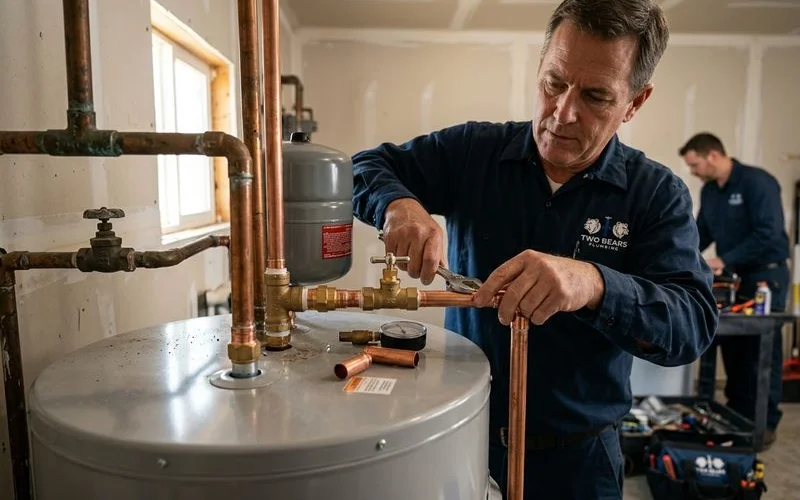
Our installation protocol at Two Bears Plumbing includes a mandatory pressure system check. If your home has a closed system, we install the required safety tank as a standard, non-negotiable part of the job. Skipping this step to save a few dollars is a massive liability.
What Does an Expansion Tank Cost?
We keep our pricing transparent because nobody likes surprise fees. An expansion tank usually adds $150 to $350 to a full water heater replacement project.
Recent 2026 data from Angi shows the national average for this specific installation sits around $325. Our rates fall perfectly in line with or slightly below the national average for a standard residential setup.
| Cost Component | Typical Price Range | What It Covers |
|---|---|---|
| The Tank Itself | $40 to $100 | The hardware, such as a 2-gallon Watts PLT-5 or an Amtrol unit. |
| Additional Fittings | $20 to $50 | Copper or PEX fittings, brass tees, and heavy-duty mounting brackets. |
| Professional Labor | $90 to $200 | Precise sizing, pre-charging the air bladder, pipe cutting, and leak testing. |
This small upfront cost acts as cheap insurance. A ruptured 50-gallon water heater causes an average of $4,000 in water damage to finished basements.
Signs You Need an Expansion Tank (If You Lack One)
We frequently inspect older neighborhoods where homes were built long before closed plumbing systems became the standard. Your system is likely crying out for help if you notice specific warning signs.
The normal municipal water pressure entering your home should sit comfortably between 50 and 60 psi. Our plumbers look for these four red flags that indicate dangerous pressure spikes:
- Discharging T&P valves: A continuous slow drip from the side of the heater is the primary symptom.
- Loud banging pipes: Rapid pressure fluctuations create a “water hammer” effect when the burner cycles on.
- Intermittent faucet drips: Excess force pushes liquid directly past your rubber valve seats in the kitchen and bathroom.
- Short appliance lifespans: Replacing units every five to seven years instead of the standard ten years points directly to expansion fatigue.
Call us at (720) 740-2481 if any of these issues sound familiar. We carry professional gauges to test your static pressure and outline a clear repair plan.
Expansion Tank Maintenance
We want you to get the maximum lifespan out of your equipment. The rubber diaphragm inside these tanks degrades over time, giving them a typical operational life of five to eight years.
A failed bladder turns the device into a heavy, waterlogged piece of useless metal.
Our technicians use a simple tap test to diagnose the health of the unit. A functioning device sounds hollow on the top half where the air lives, and solid on the bottom half where the water sits. If the entire cylinder sounds solid, the rubber has ruptured.
How to Check Your Tank Pressure
We inspect these pressure vessels during every water heater service call to catch failures before they cause property damage.
A fantastic insider tip is to check the air valve yourself. There is a standard Schrader valve under a plastic cap on the top of the tank, identical to the air valve on a car tire.
Pressing the small pin inside the valve should release a hiss of air. A sudden spray of water means the tank is completely dead.
Common Questions About Expansion Tanks
We hear a few recurring questions from clients who want to understand their plumbing better. Here are the clear answers you need to make an informed decision.
Can I install an expansion tank myself?
We strongly advise against making this a weekend project. The sizing must be exact, and the installation requires cutting into your primary cold water lines.
The most common mistake amateurs make is failing to pre-charge the tank. The air bladder pressure must exactly match your incoming street water pressure before installation. Failing to balance this pressure causes the bladder to stretch and fail within weeks.
Does my tankless water heater need one?
Our commercial and residential tankless installations face the exact same code requirements. A tankless unit heats liquid instantly, which still creates rapid thermal expansion in a closed system.
How are these units sized?
We calculate the required volume based on two main factors:
- Your water heater capacity in gallons.
- Your incoming street pressure in psi.
A standard 2-gallon expansion tank handles 40-gallon and 50-gallon water heaters perfectly. Larger 80-gallon water heaters require a 4.4-gallon model to absorb the greater volume safely.
The Bottom Line
We view this mandatory upgrade as the best defense against catastrophic plumbing failures. If you are replacing your water heater or experiencing strange pressure spikes in your home, Two Bears Plumbing is ready to assist.
Our goal is to keep your household running smoothly and safely. Call us at (720) 740-2481 or visit our contact page to schedule a comprehensive assessment.
We will inspect your pipes, verify your code compliance, and build a reliable system that lasts now that you know exactly why you need an expansion tank for your water heater in Aurora.
Need Plumbing Help in Aurora?
Call now for same-day service. Upfront pricing, no hidden fees.
Call (720) 740-2481Related Service: Learn more about our water heater services →